It’s one of the most perfect books ever written, the essence of literature refined until it’s almost a haiku. Maurice Sendak was tired of talking about Where The Wild Things are, but people still want to talk about it, because it’s so perfectly elemental, such a troubling and graceful exploration of what it means to be a child and maybe even a person. So, in spite of Sendak’s own weariness with the subject matter, a few words of appreciation about the book for which he will probably be best remembered.
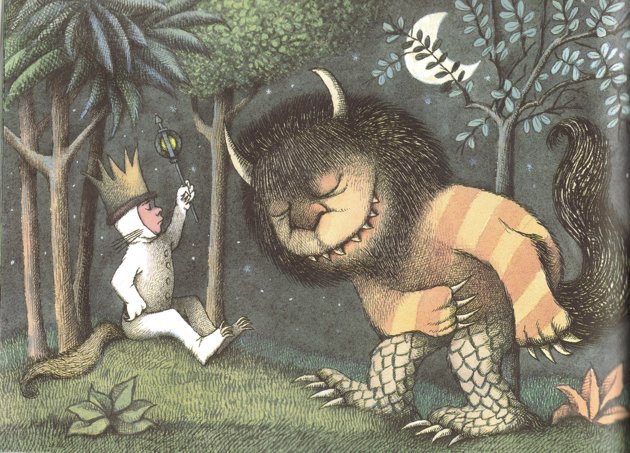
It’s a book about the deepest human experiences: love and rage, guilt and desire, the journey and the return. It shows– but does not judge– as Max acts out at home, frustrating his mother and terrifying his dog. Confined to his room, he travels in his mind to an island where he can explore his own wildness. And when the fun is over and Max is lonely and hungry, the beckoning smell of a warm dinner affirms that, though he is still punished, he’s also still loved and accepted. Many books celebrate the power of love and forgiveness, but very few do it with such eloquence.
It’s a book about a trip by boat, and has a place on the same shelf as Gulliver’s Travels, Moby Dick and Heart of Darkness. The Odyssey, which understands the promise of the horizon and the fulfillment of home, is its closest kin. But Max, who ran with the Wild Things and became their king, is braver by far than Odysseus, who would not lose himself to Circe’s enchantments or the Sirens’ songs, and so could not master them.
Like the poem in Archibald Macleish’s “Ars Poetica,” Where The Wild Things Are isn’t about—it simply is, whole and irreducible, and to make it mean something is to strip it of its charm and its truth. Are the Wild Things sex? Aggression? Creativity? Eros and thanatos? Yes, yes, yes and yes, and more—they are platonic, Wildness itself—tamed by a magic trick but always up for a rumpus.
Finally, it is beautiful, depicting a strange and haunting world of twisting vines, stately (if perturbed) sea monsters, beckoning beaches and nimbly galumphing creatures. Sendak spoke often about the importance of respecting children—and his books make that respect clear. Will there be another Maurice Sendak? I don’t think so—he was so much a product of his time and place, New York City in the Freudian Fifties. But his books—their power and their mystery—they’ll be around for a long time.

 Len Schiff: In Verse Operations
Wonderful write-up!
Thanks! There’s so much more to say about Sendak– but that’ll be for another time. Thanks for your comment!
Len, the text is in white on a white background… Vers conceptual, indeed !
Taken care of, I hope. Merci!